Shopping malls worldwide are undergoing a fundamental transformation. As traditional retail anchors decline, forward-thinking mall developers and operators are replacing them with family entertainment centers (FECs) — high-engagement, repeat-visit destinations that drive foot traffic, extend dwell time and generate revenue across multiple streams simultaneously.
The data is compelling. The global family and indoor entertainment centers market is projected to reach $76.68 billion by 2030, growing at a CAGR of 13.9%. For mall developers and commercial operators who move now, an indoor family entertainment center is one of the highest-return investments available in the retail real estate sector.
This guide covers everything mall developers, commercial operators and investors need to know about planning, designing, equipping and operating a successful indoor children’s playground for shopping malls in 2026.
Why Shopping Malls Need Indoor Family Entertainment Centers Now
The case for mall-based FECs has never been stronger. Shopping malls worldwide are replacing traditional anchor tenants with entertainment anchors. Average stay time increases to 90–120 minutes when family entertainment centers are present, compared to 45–60 minutes in 2020. This extended dwell time translates directly into increased spend across food and beverage, retail and services tenants throughout the mall.
Key strategic benefits of installing an indoor playground in a shopping mall include:
- Foot traffic generation: Families specifically travel to malls with quality children’s entertainment — making your FEC an anchor tenant that benefits all surrounding retailers
- Weekday occupancy: Family entertainment centers drive consistent weekday visitors, filling the low-traffic gaps that affect most retail malls
- Competitive differentiation: A well-designed indoor playground differentiates your mall from competitors and creates a destination that cannot be replicated by e-commerce
- Multiple revenue streams: Entry fees, birthday party packages, food and beverage, merchandise and membership programs create diversified, recurring revenue
- Tenant satisfaction: Surrounding food and beverage tenants benefit significantly from increased family foot traffic generated by the playground
Indoor Mall Playground ROI: The Financial Case
Understanding the financial performance of a mall-based indoor playground is essential for developers and investors evaluating this opportunity. Here is a realistic financial framework based on current industry data:
In the indoor playground industry, a realistic timeline to recover your initial investment is 18 to 24 months for a well-located, well-operated venue. Some high-traffic mall locations achieve full ROI in 12–18 months when birthday party revenue and membership programs are optimized from opening.
Revenue model breakdown for a typical 500–800 sqm mall indoor playground:
- General admission: Entry fees at $8–$20 per child per session, with parent supervision fees in many markets. Volume-driven revenue that scales with foot traffic
- Birthday party packages: The highest-margin revenue stream, typically priced at $150–$500 per party depending on market and package level. A venue running 8–12 parties per weekend generates substantial premium revenue
- Membership programs: Monthly memberships converting regular visitors into reliable recurring revenue, improving cash flow predictability
- Food and beverage: Integrated cafe or snack bar generating additional revenue per family visit, with margins of 60–70% on beverages
- Merchandise and photos: Branded merchandise and professional photo packages add incremental revenue with minimal additional cost
Designing a High-Performance Mall Indoor Playground
The design of your mall indoor playground directly determines foot traffic, dwell time, revenue per visitor and competitive positioning. In 2026, the most successful mall FECs share several key design principles:
Visual Impact and Social Media Appeal
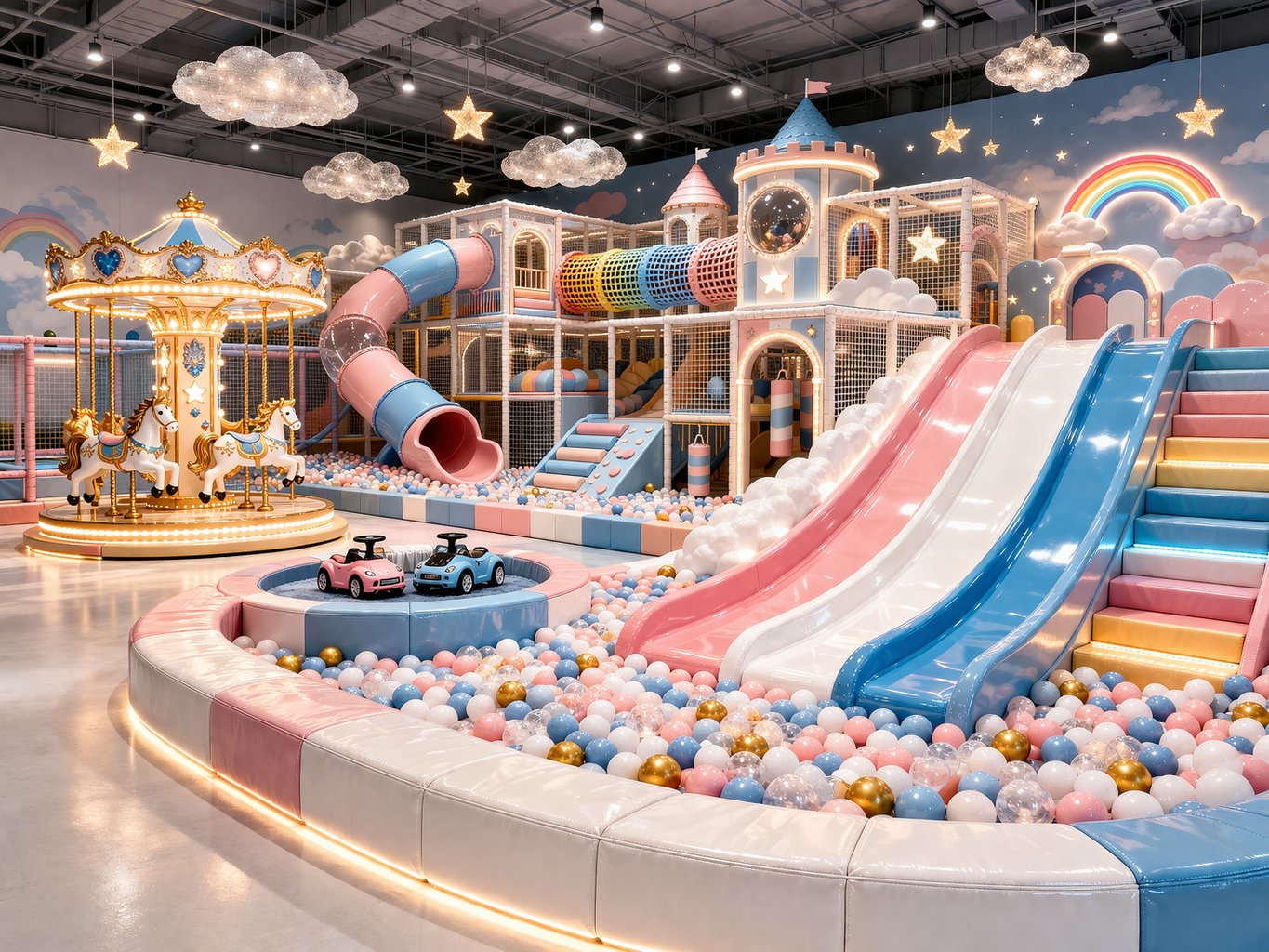
Your playground must be visually striking enough to stop shoppers in their tracks and generate organic social media content from visitors. Visual appeal is the first step to driving foot traffic — a design that naturally encourages parents to take photos generates free social media marketing for your venue. Invest in a strong theme, bold colors and signature visual elements that make your venue instantly recognizable and shareable.
Multi-Age Attraction Mix
The most profitable mall playgrounds serve children from toddlers to 12-year-olds, keeping entire families engaged simultaneously. A well-designed attraction mix includes:
- Toddler zones (1–3 years): Soft play areas, sensory play panels and low-level climbing structures with maximum padding and visibility
- Junior adventure zones (3–6 years): Themed soft play structures, small slides, ball pits and interactive play panels
- Active zones (6–12 years): Multi-level climbing structures, larger slides, obstacle courses and physical challenge equipment
- Parent comfort areas: Seating with clear sightlines to play areas, cafe integration and phone charging stations to improve parent satisfaction and dwell time
Vertical Design for Space Efficiency
Because commercial rents are rising, vertical design becomes a major trend. Vertical design maximizes experience density without increasing rent cost. Multi-level play structures make maximum use of ceiling height, delivering more play capacity per square meter of floor space — critical for managing lease cost as a percentage of revenue.
Birthday Party Room Integration
A dedicated, well-designed birthday party room is one of the highest-ROI investments in any mall playground. Position it adjacent to the main play area with clear visual separation for private events, but ensure the flow between play area and party room is seamless. Birthday party revenue typically contributes 25–35% of total revenue in well-operated venues.
Equipment Selection for Mall Indoor Playgrounds
The equipment you select determines safety, durability, maintenance costs and — most importantly — the guest experience that drives repeat visits. When working with a commercial indoor playground equipment manufacturer for a mall project, these are the key product categories to consider:
- Themed soft play structures: The centrepiece of any indoor playground, combining slides, tunnels, climbing elements and play panels in a cohesive themed environment. PlayStructureGroup manufactures custom themed structures in any design concept, from jungle adventures to space exploration to underwater worlds
- Multi-level climbing frames: Steel-framed structures with HDPE panels, netting, platforms and slides — the structural backbone of larger play zones
- Ball pit zones: High-visual-impact, high-engagement attractions that are easy to maintain and exceptionally popular with younger children
- Trampoline elements: Integrated trampoline pads and jump zones add variety and high-energy activity for older children
- Interactive play panels: Sensory and educational panels that engage younger children and support developmental play concepts valued by parents
- Safety flooring: EVA foam tiles, rubber safety flooring and padded mats are mandatory beneath and around all play structures
Safety Standards for Mall Indoor Playgrounds
Safety compliance is the foundation of any viable mall indoor playground business. Insurance requirements, mall management approval and parental trust all depend on documented compliance with recognized safety standards. The key standards for commercial indoor playground equipment:
- EN 1176 — the European standard for playground equipment safety, widely adopted globally as the primary benchmark for indoor commercial playgrounds
- ASTM F1487 — the American standard for public playground equipment, required by many insurance providers and mall operators in markets aligned with American standards
- ISO 9001 — quality management systems certification covering design, manufacturing and delivery
- GS Certification — Germany’s premium voluntary safety mark, increasingly required by sophisticated mall operators and insurance underwriters
- Fire safety compliance — all materials must meet local fire safety codes; request material fire rating certifications for all foam, fabric and plastic components
PlayStructureGroup provides ISO9001 and GS-certified equipment with full documentation for every mall playground project — including material safety data sheets, structural calculations and installation manuals required for mall management approval.
Mall Indoor Playground Cost Guide 2026
Budgeting accurately is critical for securing financing and achieving your target ROI. Here is a realistic cost framework for mall indoor playground projects in 2026:
- Small mall play zone (200–400 sqm): $30,000 – $80,000 for equipment, excluding fit-out, flooring and signage
- Standard mall FEC (400–800 sqm): $70,000 – $180,000 for a complete themed equipment package with multi-level structures
- Premium large-scale FEC (800–1,500 sqm): $150,000 – $400,000 for a fully themed, multi-zone venue with trampoline elements and dedicated party room
Sourcing equipment factory-direct from PlayStructureGroup reduces equipment costs by 30–50% compared to purchasing through local distributors, without compromising on certification or quality. Though safety equipment conforming to the specifications of ASTM and EN standards will generally cost more at the start, it reduces the cost of insurance, maintenance, and claims in the long run by reducing the risk of injury.
Why Mall Developers Choose PlayStructureGroup
PlayStructureGroup has delivered indoor playground projects for shopping malls, mixed-use developments and family entertainment centers across Africa, the Middle East, Southeast Asia and Europe. With 15+ years of experience, 3,000+ completed projects, ISO9001 and GS certification, and a specialized mall playground design team, we deliver factory-direct equipment with complete project support.
Our mall playground service includes: free 3D concept design and layout planning, certified equipment manufacturing, global logistics coordination, installation support and structured after-sales maintenance. Every project is managed by a dedicated project coordinator from first consultation to handover.
Start Planning Your Mall Playground Today
Whether you are a mall developer evaluating the FEC opportunity, a commercial operator ready to buy indoor playground equipment, or an investor planning a new family entertainment center, PlayStructureGroup is ready to help.
Contact us today for a free project consultation. Tell us your mall location, available space, target age groups and budget — and we will provide a full 3D design concept and itemized equipment proposal within 24 hours.
WhatsApp: +33 7 6871 66 82 | Website: playstructuregroup.com/contact | Factory: Yangwan Industrial Area, Yongjia, Wenzhou, China